Floor Scrubber Leaving Streaks? Troubleshooting Guide.
Published · Updated
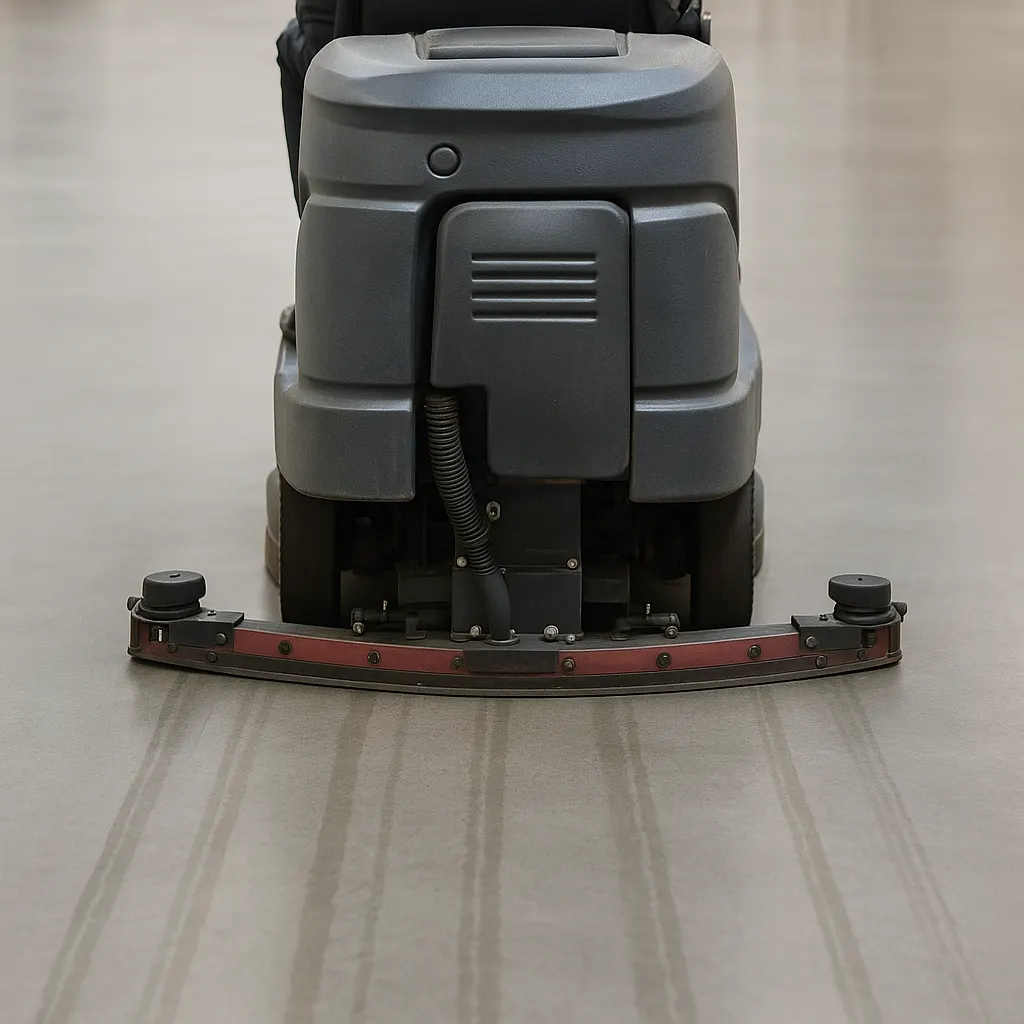
If your floor scrubber is leaving streaks, you’re not alone. Below is a quick, practical guide to diagnose and fix streaks on autoscrubbers (walk-behind and rider). Work through the checklist in order; most streak problems are solved in minutes.
Quick Fix Checklist (Do These First):
-
Pick up debris: Large grit, pallet chips, zip-ties, and shrink wrap tails catch under the squeegee and blade. Pre-sweep or remove visible debris.
-
Wipe the squeegee blades: Flip or drop the squeegee, and wipe both lip edges with a damp rag. A pebble or clump of hair can create streaking.
-
Empty the recovery tank: A full or clogged recovery system kills suction and leaves wet, streaky trails.
-
Slow down: Water recovery needs time. Reduce travel speed on passes where water is being picked up.
-
Use fresh/clean pad or brush: Loaded pads smear soils and chemicals, creating residue bands.
If streaks persist, continue below.
Step-By-Step Troubleshooting.
- Squeegee Blades: Condition, Angle, and Pressure:
-
Check blade edge: Look for nicks, waves, or rounding. A crisp, straight edge is key.
-
Blade orientation: Most blades are four-edged; rotate to a fresh edge if worn.
-
Blade angle & float: The squeegee should trail evenly with light, even contact. If the center is dry and ends are wet, reduce down-pressure or adjust pitch. If the center is wet and the ends are dry, increase the pitch or inspect the center vacuum slot for blockage. Consult your floor scrubber’s operator’s manual for instructions on how to do this.
-
Tighten/align: Uneven caster height or a bent squeegee frame causes one-sided streaks.
Need new squeegees? Order OEM-fit blades and seals from our team: Wisconsin Scrub & Sweep Service & Parts »
- Suction Health: Hoses, Gaskets, and Vacuum Motor.
-
Hose inspection: Check recovery and squeegee hoses for cracks, pinholes, loose cuffs, or clogs.
-
Gaskets & lids: Ensure the recovery tank lid gasket seals tight; leaks = low lift = streaks.
-
Float shutoff: If the ball float is stuck or the filter screen is gunked up, you’ll lose suction—clean it.
-
Vac motor: Listen for even tone. If the sound is weak/uneven, check the vac filter and wiring before assuming the motor is bad.
- Pad/Brush & Deck Settings.
-
Pad choice: Too aggressive pads can micro-gouge softer finishes; too soft pads just smear. Match pad to soil and floor type.
-
Saturated pads: Swap or rinse mid-shift—loaded pads make chemical streaks.
-
Down pressure: Excess pressure floods the path and overwhelms recovery; back it down and check.
-
Deck skirt: Torn or missing skirts cause slurry to flow past the squeegee line.
- Water & Chemical Variables.
-
Over-mixing detergent: Heavy solution leaves residue halos. Follow label dilutions precisely.
-
Hard water: Mineral film can streak; try RO/soft water or add a rinse pass.
-
Defoamer: A small amount of defoamer in the recovery tank helps reduce foam that can clog suction.
- Operator Technique.
-
Two-pass method: For heavy soils, do a scrub pass, then a pickup pass (vac on, little/no solution).
-
Overlap: Overlap each pass 2–3 inches so the squeegee picks up the previous line.
-
Speed: If you see a watery tail, slow your travel speed until the path dries behind you.
When to Replace the Squeegee (Rule of Thumb).
-
You see rounded, shiny edges, nicks, or cupping.
-
You’ve already rotated all edges.
-
You need to increase pressure just to get pickup.
-
You’re seeing repeating lines in the exact wheel or frame locations.
Save time: grab the right blades for your machine by model. Shop WSS Service & Parts.
Still Seeing Streaks? We Can Help.
Wisconsin Scrub & Sweep diagnoses streak issues every day—blade fitment, vac leaks, pad selection, even oddball causes like collapsed hose liners or warped frames. If you want a tech to sanity-check your setup or spec the correct squeegee compound (gum, urethane, Linatex-style), we’re happy to help.
→ Contact our Service & Parts team
FAQ: Floor Scrubber Streaks:Why does my scrubber only streak on turns?
The squeegee can “chatter” or lift during sharp turns. Slow the turn, ensure even caster heights, and check that the squeegee pitch isn’t too aggressive.
Why is the floor hazy after drying?
That’s usually chemical residue. Reduce detergent concentration, rinse with clean water, and verify pad choice.
Why do streaks come back a day later?
Soils left in the pores re-wick. Try a slower pickup pass, fresh pads, and confirm the vacuum lift is strong.