
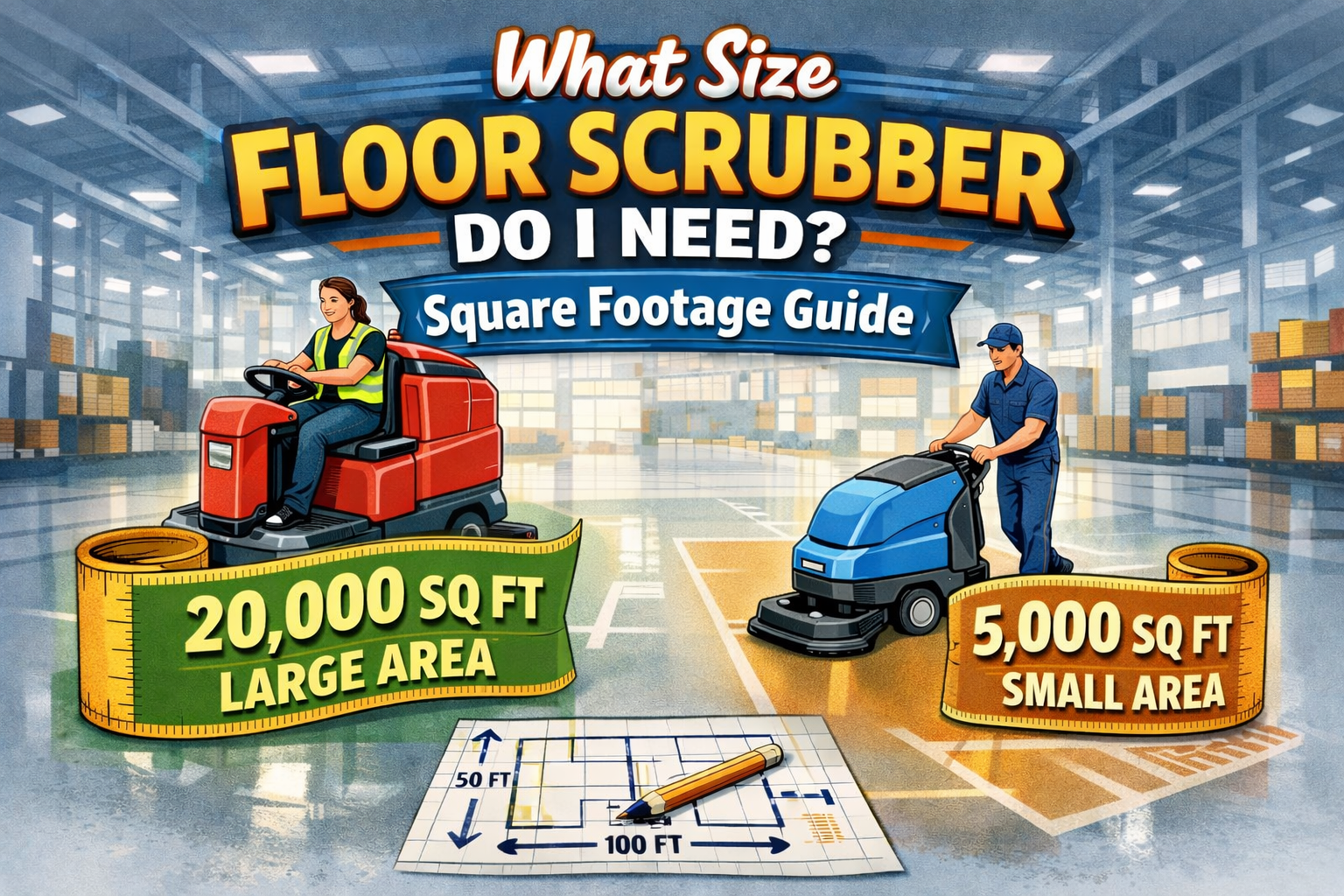
If you’re shopping for a floor scrubber, this is the question that matters most: What size machine actually fits my building?
Buy too small and you waste labor hours every week.
Buy too large and you overspend on equipment you don’t need.
Below is a practical, real-world sizing guide based on brush deck width (the cleaning path in inches). When we reference 17", 28", 36", etc., we are specifically referring to the brush deck size, not overall machine width.
Floor Scrubber Size Guide by Facility Square Footage:
---------------------------------
Under 5,000 sq ft
→ 17"– 20" walk-behind scrubber
---------------------------------
5,000–15,000 sq ft
→ 24"– 28" walk-behind scrubber
---------------------------------
15,000–25,000 sq ft
→ 28"– 36" walk-behind
→ OR 20"– 30" rider scrubber
---------------------------------
25,000–40,000 sq ft
→ 30"– 36" rider scrubber
---------------------------------
40,000–100,000 sq ft
→ 36"– 46" rider scrubber
---------------------------------
Over 100,000 sq ft
→ 46"– 56" rider scrubber
---------------------------------
This guide assumes:
- Concrete or sealed industrial floors.
- Regular weekly or daily cleaning.
- Open warehouse-style layouts.
If your building has tight aisles, heavy obstacles, or narrow corridors, sizing may adjust slightly.
Why Size Matters More Than People Think:
The difference between a 20” walk-behind and a 36” rider doesn’t just affect speed — it affects:
- Labor hours per week.
- Operator fatigue.
- Water dump/refill cycles.
- Long-term productivity.
A larger scrub deck means fewer passes and fewer total cleaning hours.
For example:
- A 20” walk-behind may realistically clean ~8,000–12,000 sq ft per hour.
- A 36” rider may clean ~25,000–35,000 sq ft per hour.
- A 46” rider can exceed 40,000 sq ft per hour in open space.
Theoretical cleaning rates listed by manufacturers are often higher — real-world conditions bring those numbers down.
Walk-Behind vs Rider: When Should You Step Up?
Many facilities in the 15,000–25,000 sq ft range sit on the fence.
Here’s a practical rule:
If cleaning takes more than 2–3 labor hours per session, it’s worth pricing a rider.
Rider scrubbers:
- Reduce operator fatigue.
- Increase cleaning speed.
- Often pay for themselves in labor savings over time.
That’s why many warehouses jump to a rider sooner than expected.
Other Factors That Influence Sizing:
Square footage is the starting point, not the only factor.
You should also consider:
- Aisle width (can a rider maneuver?).
- Tank size (larger decks usually mean larger tanks).
- Battery type (wet cell vs AGM vs lithium).
- Cleaning frequency (daily vs weekly).
- Floor condition (heavy soil vs light maintenance cleaning).
If your building is 60,000 sq ft but tightly packed with shelving, a smaller rider may outperform a larger one.
Disk vs Cylindrical Scrub Decks:
This guide assumes disk-style brush decks, which are most common.
Cylindrical scrub decks:
- Sweep and scrub in one pass.
- Are helpful in debris-heavy environments.
- Typically increase machine cost by ~10%.
Deck type doesn’t usually change sizing recommendations — but it can impact budget.
Common Sizing Mistakes:
- Buying too small to “save money”.
- Ignoring operator fatigue.
- Focusing only on purchase price instead of labor cost.
- Using manufacturer theoretical cleaning rates instead of real-world productivity.
The right size machine should feel appropriately matched — not maxed out every time it runs.
Still Not Sure What Size You Need?
At Wisconsin Scrub & Sweep, we help facilities across the state match:
- Building size.
- Layout.
- Cleaning frequency.
- Budget.
👉 Learn more about our floor scrubber sales, rentals, and service at:
https://wisconsinscrubandsweep.com
If you want help narrowing it down, we’re happy to walk through your square footage and layout!