
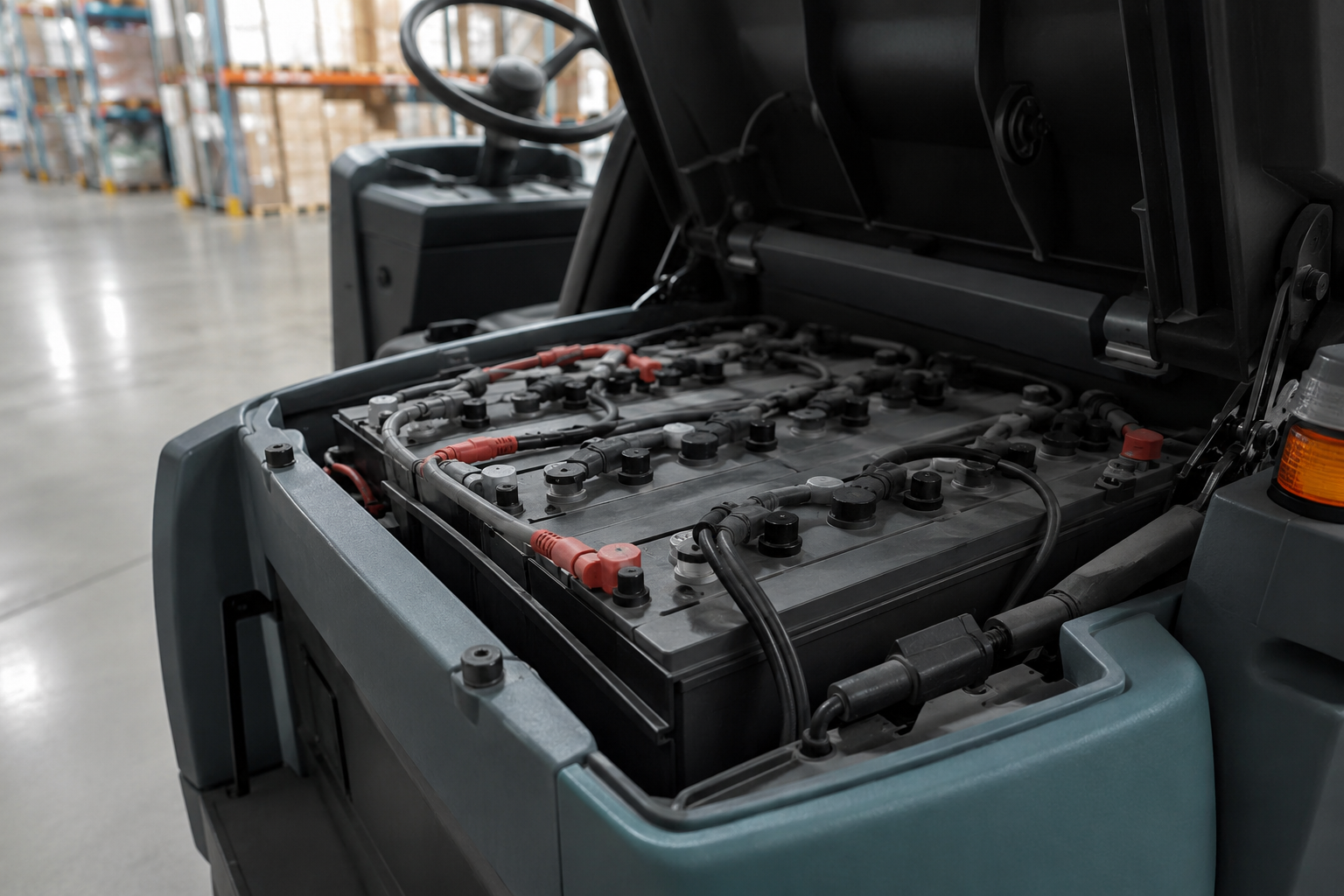
The battery is the single most expensive part of your floor scrubber that you'll replace more than once. It also decides how many hours your machine runs, how much time your crew spends babysitting a charger, and how much maintenance lands on your plate every month.
So when you're speccing a new Factory Cat or Kodiak floor care machine— or planning a replacement for a machine you already own — the lead-acid vs lithium-ion question is one of the most important calls you'll make. Here's the straight version, with no sales spin.
The two battery types, side by side
Lead-acid batteries have powered floor scrubbers for decades. They're proven, they're affordable up front, and almost every machine on the market can run them. There are two flavors: flooded (wet) lead-acid, which needs periodic watering, and sealed AGM, which doesn't. Both are heavy, both lose runtime as they discharge, and both want a full, uninterrupted charge to live a long life.
Lithium-ion batteries are the newer option, and they've come down in price enough to be a serious choice for industrial floor care. They're lighter, they hold steady voltage through the whole shift, they charge fast, and they don't need watering or equalizing. The catch is a higher sticker price — which is exactly why you have to look past the sticker.
Up-front cost vs cost over time
This is where most buyers get tripped up. Lead-acid wins the day you write the check. Lithium-ion usually wins over the life of the machine.
A lead-acid pack costs less to buy, but in heavy use it typically needs replacing every few years, and every improper charge or deep discharge shortens that clock. Lithium-ion costs more up front but commonly lasts two to three times as many charge cycles, which often means you buy one lithium pack instead of two or three lead-acid packs over the same stretch.
If your scrubber runs a shift a day, five days a week, the math frequently lands in lithium's favor. If the machine only comes out a few hours a week, lead-acid's lower entry cost can be the smarter play. Run-hours are the deciding number — not the price tag.
Charging and uptime
Lead-acid wants a long, slow, complete charge — usually eight hours or more — and it does not like being topped off in short bursts. Interrupt the charge cycle repeatedly and you'll cook the pack early. For a single-shift operation with the machine parked on a charger every night, that's a non-issue.
Lithium-ion is built for opportunity charging. Plug it in over a lunch break or between runs, pull it off, and go — no harm done. For two- and three-shift facilities, or any operation where the scrubber rarely gets a full overnight rest, that flexibility is the whole ballgame. You keep the machine working instead of waiting on a charger.
Maintenance and labor
Flooded lead-acid needs watering on a schedule. Skip it and you'll kill the battery; overfill it and you've got acid on the floor and corroded terminals. That's real labor and a real safety task someone on your team owns every week.
Sealed AGM lead-acid drops the watering but still wants careful charging. Lithium-ion is essentially maintenance-free — no watering, no equalizing, no acid to deal with. For a lean crew that's already stretched, taking a recurring task off the board has value that doesn't show up on the price sheet.
Temperature — and why this matters in Wisconsin
Battery chemistry cares about temperature, and around here we see both ends of it. Lead-acid loses noticeable capacity in the cold, so a scrubber working a cold storage or freezer facility in January will get fewer runtime hours than the spec sheet promises. Heat is hard on lead-acid too, shortening its life over the summer months.
Lithium-ion holds up better across a wider temperature range, though the very coldest freezer applications still call for a battery rated for it. If your floors live in extreme temperatures, that's worth a conversation before you buy.
So which one should you choose?
Here's the short decision guide:
Lean toward lead-acid if: the machine runs light or occasional duty, your budget is tight up front, you have a reliable overnight charging routine, and your crew is fine with basic battery upkeep.
Lean toward lithium-ion if: you run multiple shifts or heavy daily hours, you need opportunity charging to keep the machine moving, you want to drop battery maintenance entirely, or you're working in cold or temperature-swinging environments.
Both Factory Cat and Kodiak machines can be configured with the right battery for your operation — from compact walk-behinds up to full-size riders like the Kodiak K42. The wrong battery on the right machine still costs you runtime and money, so it's worth getting the pairing right the first time.
FAQ
Can I switch my lead-acid scrubber to lithium later? Often yes, depending on the machine and charger. It's not always a simple swap, so check the specifics before you count on it. We can tell you whether your model supports it.
Does lithium-ion really last that much longer? In cycle life, yes — it's commonly rated for two to three times the charge cycles of comparable lead-acid, which is the core of the long-term cost argument.
Is lithium-ion safe for industrial use? Modern lithium packs built for floor equipment include battery management systems that handle charging and protect against overheating. They're a well-established option in industrial floor care.
At Wisconsin Scrub & Sweep, we make buying and outfitting floor care equipment simple. Whether you're speccing a brand-new Factory Cat or Kodiak or figuring out the right battery for the machine you already run, our team will walk you through the trade-offs honestly — no pressure, no runaround. Take a look at our new Factory Cat and Kodiak equipment, or if you need a hand with an existing machine, our service and parts team has you covered. Give us a call at (262) 333-0799 or reach out online — we'd love to earn your business!