
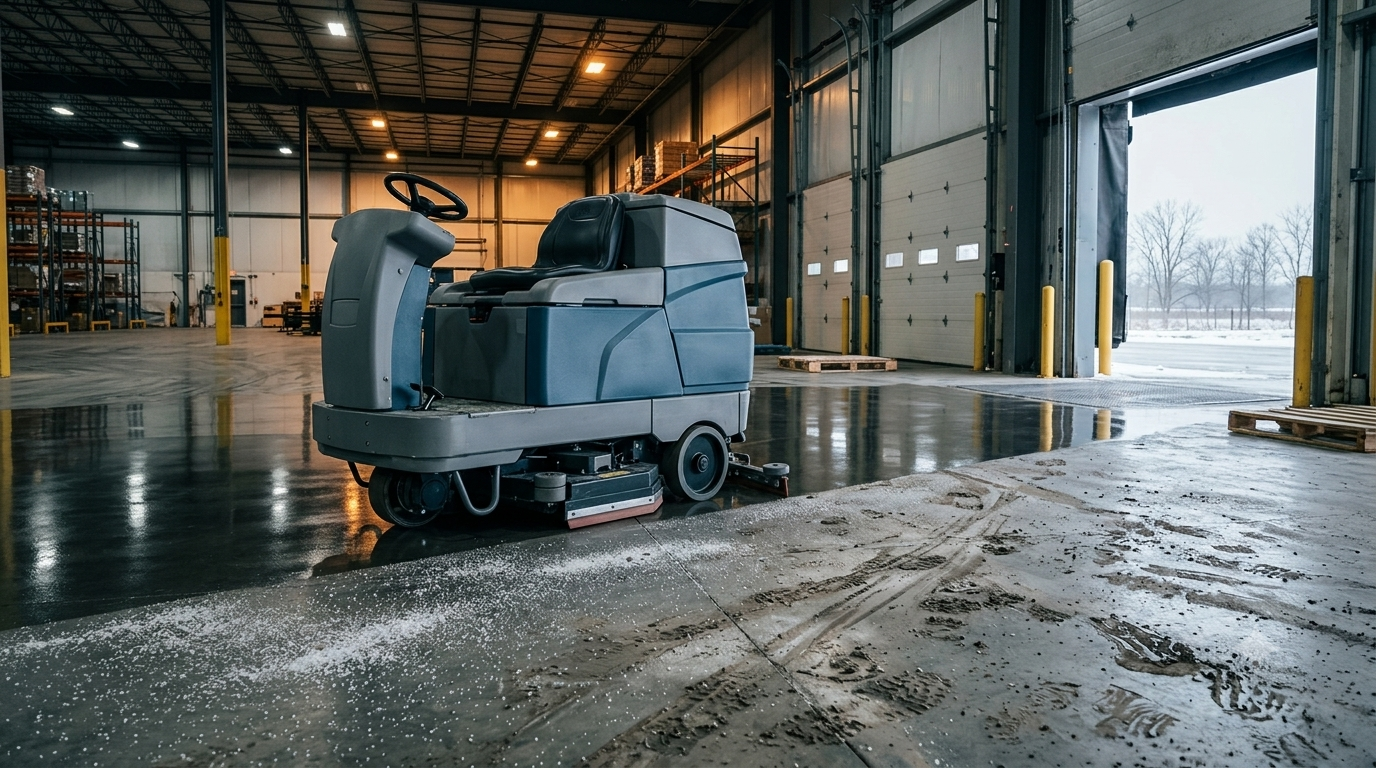
The first hard freeze in southeastern Wisconsin usually shows up sometime in late October. The salt trucks aren't far behind. And by the second week of December, a plant manager is going to walk out to the scrubber, find squeegee blades chewed to ribbons and a white haze across the floor that won't come up, and start making phone calls.
That call doesn't have to happen. Almost everything that goes wrong with a floor scrubber in January is something you could have handled in September.
Fall is the cheapest, quietest window you get all year to prepare. Parts are available, service calendars aren't jammed, and your floors haven't started collecting five months of tracked-in salt.
Here's what to work through before the weather turns.
Winter Is a Salt Problem, Not a Cold Problem
Your scrubber lives inside. It's not going to freeze, and it's not going to lose half its runtime because it's twelve degrees outside.
What it is going to do is fight rock salt and ice melt for the next five months. That residue comes in on forklift tires, boot treads, and pallet jacks, and it never stops arriving. It's abrasive and chemically aggressive — it scours squeegee blades, grinds into the scrub deck, works its way into the recovery tank, and leaves a white film on the floor that makes an otherwise spotless facility look neglected.
Add slush and melt water tracked in from the lot, and you've got a floor that's wetter, dirtier, and more of a slip risk than it is any other time of year.
The machines that come through the season well are the ones that went into it with fresh consumables and a clean water path. That's a fall job.
1. Stop the Salt at the Door
The most effective floor care strategy in winter isn't a machine setting. It's keeping salt out of the building in the first place.
Run matting long enough to actually work. The general rule is fifteen feet of walk-off matting to capture most of what's on a boot sole — most facilities run about a third of that. Add a scraper mat outside the door, and scrub your entryway zones more often than the rest of the building. Entry areas are always your highest-wear floor, and they're the first thing a visitor sees.
For facilities with heavy dock traffic, a dedicated sweeper working the aprons and outer bays keeps a real share of the grit from ever reaching your interior floor. Every pound stopped at the door is a pound your scrubber doesn't have to grind through.
2. Squeegee Blades Take the Worst of It
Salt residue doesn't just sit on the floor — it rides the squeegee blade for the entire scrub path, all shift, every shift. Nothing on the machine wears faster in winter.
A blade that's rounded, nicked, or hardened won't pull a clean line of water. You get streaking, a wet trail behind the machine, and a slip hazard in exactly the season when floors are already wet from tracked-in snow.
Inspect the blades now, rotate them if there's a good edge left, and have a spare set on the shelf before December rather than ordering after the streaks show up. Blades are inexpensive; a slip-and-fall investigation is not.
While you're back there, check the squeegee hose and vacuum path for debris. A partial blockage acts a lot like a worn blade, and people replace the blade first.
3. Brushes and the Scrub Deck
Pull the brushes and check bristle length. Worn bristles don't reach the floor with the pressure the machine was designed to deliver, so the deck works harder and cleans worse.
It's also worth asking whether you have the right brush for the season ahead. Winter floors carry a heavier, grittier soil load, and a more aggressive brush or pad can be the difference between one pass and three.
Facilities running cylindrical decks — like the ones across much of the Factory Cat lineup — have an advantage here, because the cylindrical design sweeps debris into a hopper while it scrubs. When your entryways are loaded with sand and salt granules for four straight months, a deck that picks debris up instead of pushing it around saves you a separate sweeping pass.
4. Flush the Tanks and Clear the Filters
This is the one most facilities skip, and it's the one that turns into a repair bill.
Salt-laden recovery water leaves deposits. Over a season they build up in the tank, coat the float shutoff, and clog the drain. Before winter, run a full flush of both the solution and recovery tanks, then pull and clean the solution and vacuum filters. Check the tank gaskets and lid seals — a marginal seal costs you vacuum lift, and reduced lift means water left on the floor.
Then build a habit for the season: empty and rinse the recovery tank at the end of every shift, not every few days. Standing salt water is what turns a maintenance item into a repair.
5. Revisit Your Chemistry
The cleaner that works fine in July may be the wrong tool once ice melt enters the building.
Ice melt residue is alkaline, and a general-purpose alkaline detergent doesn't do much with it — you end up spreading a film rather than removing it. Many facilities switch to a neutral or mildly acidic cleaner formulated for salt residue through the winter, then switch back in spring.
Whatever you use, follow the dilution. Over-concentrating is the most common cause of the hazy film people blame on their machine.
6. Plan for the Shutdown Weeks
Batteries aren't a winter problem for an indoor machine — but a two-week holiday shutdown is.
A pack that sits partially discharged for a couple of weeks doesn't come back the same. Before the plant goes quiet, charge the batteries fully and leave them on the charger if your setup allows it. Drain and rinse the tanks so nothing sits stagnant, and clean any corrosion off the terminals while you're at it.
If runtime has already been slipping — operators saying "it doesn't last like it used to" — fall is the right time to sort that out, not the week you come back.
7. Book Service Before Everyone Else Does
Service calendars fill up fast once the weather turns. A preventative maintenance visit scheduled in September happens on your timeline. The same request in January happens on whatever timeline is available.
A fall PM visit does more for you than anything else on this list, because it catches what an operator walk-around won't — motor brush wear, hose fatigue, drive system condition, wiring that's started to chafe.
If you're running Factory Cat or Kodiak equipment, we'd rather find the problem in October than get the emergency call in January. You can schedule service or order parts any time — the earlier in the fall, the better the calendar looks.
Frequently Asked Questions
When should I start winter prep on my floor scrubber? September through mid-October is the sweet spot in Wisconsin. Parts and service availability are good, and you're ahead of both the first salt and the Q4 shipping crunch that takes over your maintenance window.
How often should I scrub during salt season? More often than the rest of the year, and unevenly. Entryways, dock aprons, and main traffic aisles may need daily attention while back areas stay on their normal schedule. Salt does its damage by sitting.
Do I need a different machine for winter, or just different settings? For most facilities it's chemistry and consumables, not a different machine. It becomes a hardware question when your winter soil load is heavier than your current deck can handle in one pass. If operators are running the same aisle twice all winter, the machine is undersized for the season.
What's the single most-skipped step? Rinsing the recovery tank daily. Two minutes, and it prevents most of the tank, hose, and float problems that show up in spring.
What should I do with the machine over a holiday shutdown? Tanks drained and rinsed, batteries fully charged. Those two things cover most of what goes wrong during an extended idle stretch.
Get Ahead of Salt Season
At Wisconsin Scrub & Sweep, we make owning and maintaining floor care equipment simple. Whether you need a fall PM visit, a spare set of squeegee blades before the first storm, or an honest answer about whether your machine will handle another winter, our team is here to help — no pressure, no runaround.
We're local, we know what a Wisconsin winter does to an industrial floor, and we stand behind the Factory Cat and Kodiak equipment we sell and service. If your machine isn't going to make it through the season, we keep rental scrubbers and sweepers available so you're never stuck.
Give us a call at (262) 333-0799 or reach out online — we'd love to earn your business.