
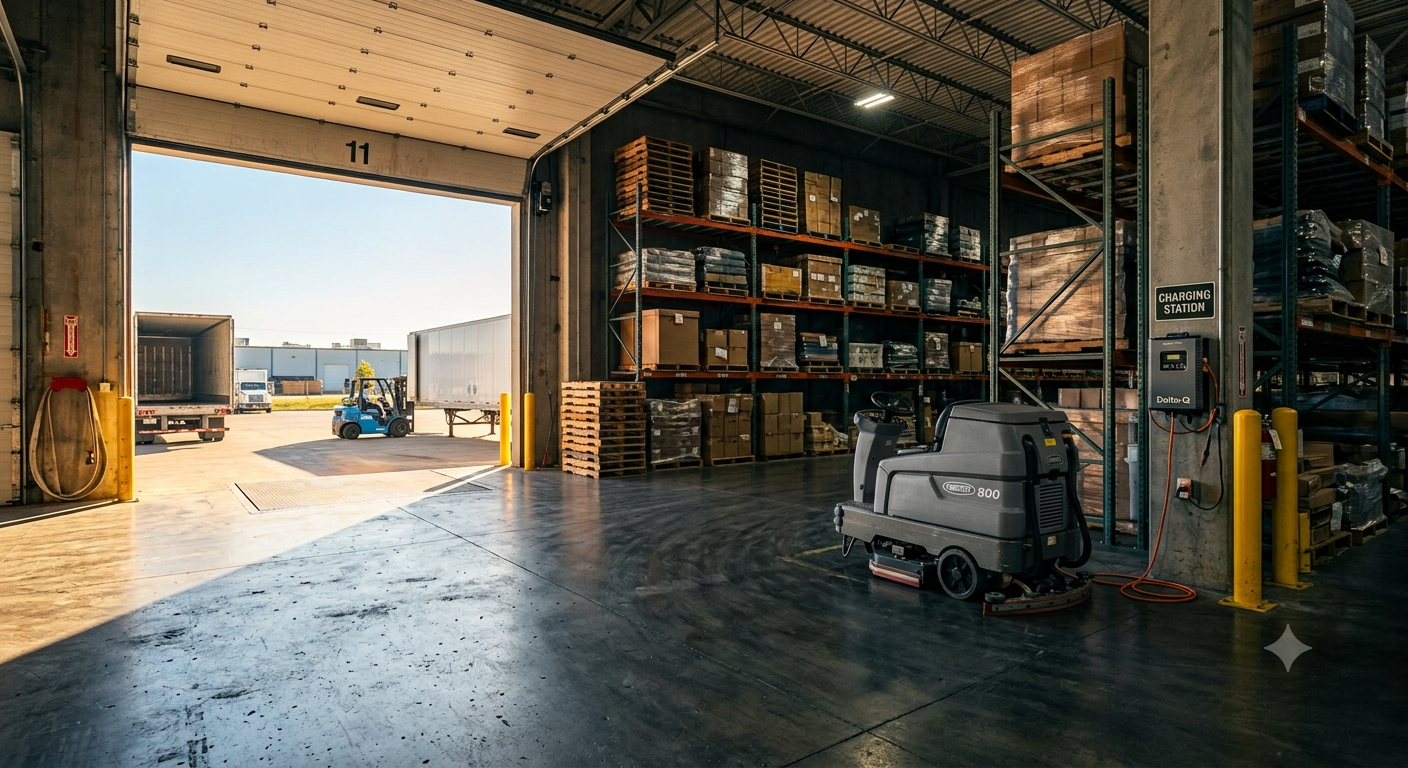
Wisconsin summers don't mess around. Once July hits, loading docks turn into ovens, mezzanines trap heat near the ceiling, and any battery-powered equipment sitting near an open bay door is baking right alongside the concrete. Your floor scrubber's battery feels every bit of it.
Heat is one of the fastest ways to shorten battery life on a floor scrubber or sweeper — faster than normal daily wear, faster than a few missed maintenance checks. The good news: most of the damage is preventable if you know what to watch for during the hottest stretch of the year.
Why Heat Hits Batteries Harder Than You'd Think
Batteries don't fail gracefully in the heat — they degrade quietly, and you usually don't notice until runtime drops or the machine won't hold a charge through a full shift.
Lead-acid batteries lose water faster in high heat, which accelerates plate corrosion and sulfation if levels aren't checked often enough. A battery that normally needs watering every few weeks might need it weekly during a Wisconsin heat wave.
Lithium-ion batteries handle heat swings better overall, but they're not bulletproof either — charging a lithium pack at extreme temperatures can still reduce long-term capacity if the equipment sits in direct sun or a poorly ventilated charging area.
Either chemistry, the underlying problem is the same: heat accelerates chemical reactions inside the battery, and most of those reactions are the ones you don't want sped up.
Charging Practices That Matter More in Summer
A few habits make a real difference from June through August:
- Charge during cooler hours when possible — early morning or overnight, rather than mid-afternoon when the facility is at its hottest.
- Ventilate the charging area. Batteries generate their own heat while charging, and stacking that on top of a hot facility compounds the problem fast.
- Don't opportunity-charge in extreme heat. Topping off a partially charged battery in the middle of a 90-degree afternoon puts more thermal stress on the cells than a full, planned charge cycle.
- Check water levels weekly on lead-acid units during peak summer, not monthly. It's a five-minute check that prevents a much bigger problem.
Where You Store (or Park) the Machine Matters
It sounds obvious, but it gets overlooked constantly: don't let an idle scrubber sit next to an open dock door or in a patch of direct sun coming through a skylight. Facilities with loading areas that see heavy summer sun should treat equipment parking the same way they'd treat a forklift battery room — shaded, ventilated, and out of the direct heat path.
If your facility doesn't have a climate-controlled equipment area, even relocating the machine 20 feet away from a hot bay door during off-hours can meaningfully extend battery life over a season.
Signs Your Battery Is Struggling With the Heat
Watch for these during summer months specifically:
- Runtime dropping noticeably compared to spring performance.
- Charge times getting longer for the same charge level.
- Visible corrosion or swelling around battery terminals.
- The machine losing power mid-shift when it didn't before.
Any of these showing up in July or August, when they weren't a problem in April, is almost always heat-related — not a sign the battery is simply "getting old." Catching it early is the difference between a battery that lasts another season and one that needs replacing before fall.
When It Makes Sense to Move to Lithium-Ion
If your facility runs equipment in consistently hot conditions — food and beverage plants with wash-down areas, manufacturing floors near ovens or kilns, or warehouses with poor dock ventilation — lithium-ion is worth a serious look. It handles heat cycling better, needs no watering, and holds a more consistent charge across temperature swings than lead-acid.
Several Factory Cat and Kodiak models offer lithium-ion as a factory or upgrade option, and it's a conversation worth having if summer heat has been chewing through your current batteries faster than it should. Browse the current Factory Cat lineup to see what's available with lithium-ion, or talk to our team about retrofitting existing machines where it makes sense.
Don't Skip the Mid-Summer Check-In
Even well-maintained batteries benefit from a mid-season look, especially heading into the hottest stretch of July and August. If it's been a while since your equipment had a real once-over, our service and parts team can check charge cycles, terminal condition, and water levels before heat damage turns into a full battery replacement.
FAQ
Does heat affect lithium-ion batteries the same way it affects lead-acid? No — lithium-ion handles heat swings better overall, but it's still not immune. Charging in extreme heat or storing equipment in direct sun can shorten lithium battery life too, just less dramatically than with lead-acid.
How often should I check water levels on a lead-acid battery in summer? Weekly during peak heat months is a safe rule of thumb, compared to monthly checks the rest of the year. Water loss accelerates with temperature.
Can I keep charging my scrubber the same way I do in winter? Not ideally. Charging during cooler parts of the day and avoiding opportunity charging in extreme afternoon heat both help extend battery life through summer.
Is it worth switching to lithium-ion just for the heat resistance? If your facility runs consistently hot — near ovens, wash-down areas, or poorly ventilated docks — the reduced heat sensitivity, lower maintenance, and consistent charge performance often make lithium-ion worth the upgrade cost over time.
At Wisconsin Scrub & Sweep, we make buying and servicing floor care equipment simple. Whether you're weighing a switch to lithium-ion or just want your current equipment checked before the worst of summer hits, our team is here to help you find the right solution — no pressure, no runaround. Explore our current Factory Cat and Kodiak equipment or reach out to our service and parts team directly. Give us a call at (262) 333-0799 or reach out online — we'd love to earn your business.