
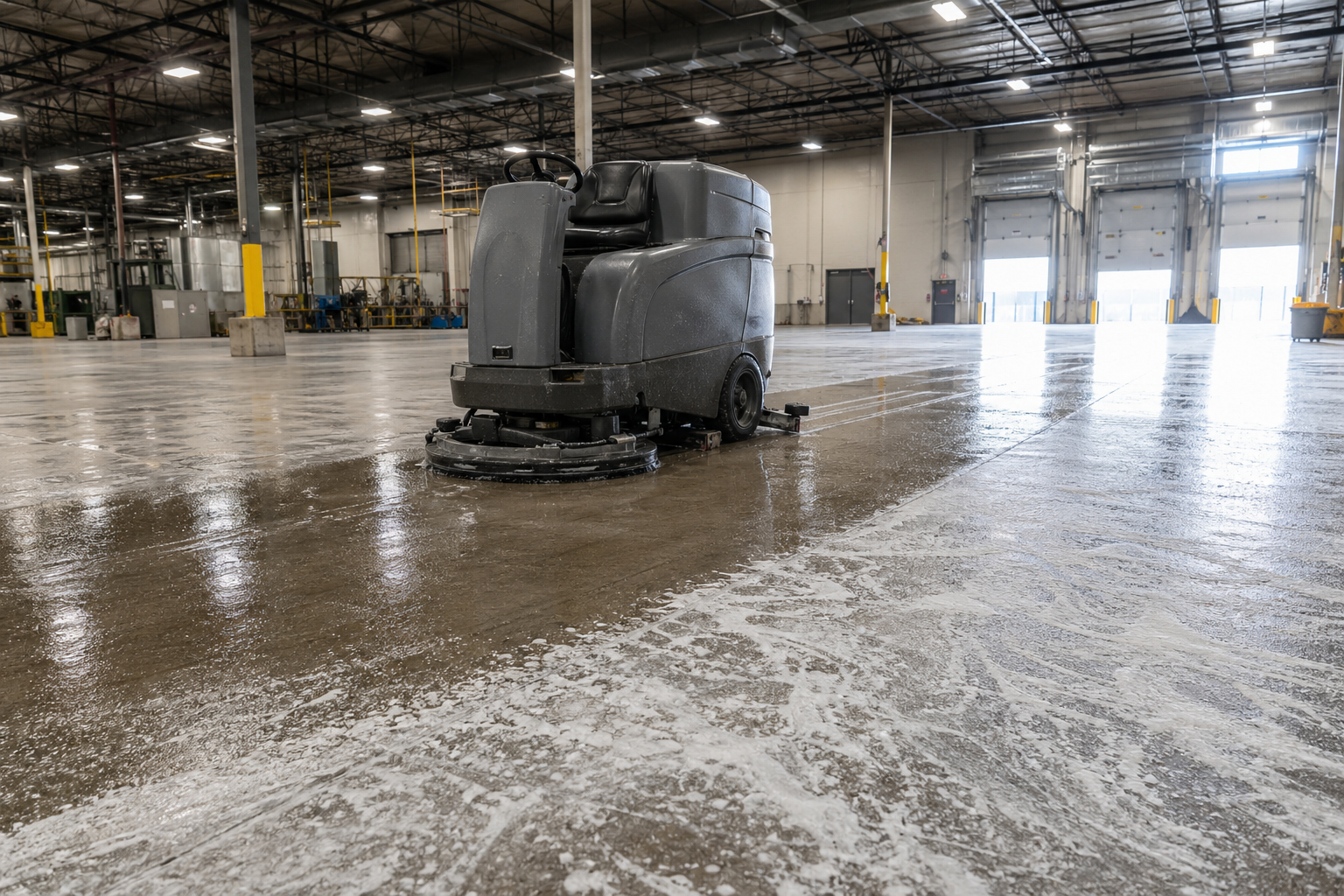
Winter in Wisconsin doesn't just test your patience — it tests your floors. Months of road salt, ice melt, and de-icing chemicals get tracked into your facility on boots, forklifts, and pallet jacks. By the time April rolls around, that buildup has had plenty of time to do damage.
If your concrete floors look hazy, white-streaked, or feel gritty even after routine scrubbing, you're seeing the aftermath. Here's how to actually fix it — and how to set your facility up so next winter doesn't hit as hard.
Why Salt and Ice Melt Residue Is a Bigger Deal Than It Looks
Salt and chemical de-icers are corrosive. On bare concrete, they seep into the pores of the slab and start breaking down the surface from within. On coated or sealed floors, they attack the finish, causing clouding, peeling, and premature wear.
Beyond surface damage, residue buildup creates real safety and operational problems:
- Slip hazards — wet salt film is deceptively slick, especially under forklift traffic.
- Dust and grit — dried residue becomes airite particulate that gets into machinery, product, and HVAC systems.
- Coating failure — if you recoat or seal over residue, the new finish won't bond properly.
The longer it sits, the harder it is to remove. A spring deep clean isn't optional — it's maintenance.
Step 1: Assess the Damage
Walk your facility with fresh eyes. Pay attention to:
- Entry points and dock doors — these are ground zero for salt tracking.
- Forklift travel lanes — tires spread residue across the entire floor.
- Corners and edges — where mop water and scrubber recovery miss, residue accumulates.
- Coated areas — look for clouding, bubbling, or soft spots in epoxy or urethane finishes.
If you're seeing white haze or crystalline buildup in low-traffic areas, the problem is worse than the high-traffic zones suggest — heavy foot and wheel traffic just grinds the salt in rather than letting it sit visibly on top.
Step 2: Choose the Right Chemistry
Standard floor cleaner won't cut it. Salt and ice melt residue require a neutralizing detergent — something formulated to break the chemical bond between the residue and the floor surface.
Look for a cleaner with a mild acid or chelating agent designed for mineral deposit removal. Your equipment dealer or chemical supplier can recommend the right product for your floor type. The key is matching the chemistry to the surface: bare concrete, sealed concrete, and epoxy coatings each respond differently.
Important: Do not use vinegar or muriatic acid as a DIY shortcut on coated floors. You'll strip the finish faster than the salt ever would.
Step 3: Scrub With the Right Equipment
This is where your floor scrubber earns its keep. A proper spring recovery scrub is not the same as your daily cleaning pass.
Adjust your machine setup for deep cleaning:
- Slow down your travel speed. Give the brush and solution more dwell time on the floor. Residue that's been sitting for months won't release in a single fast pass.
- Increase solution flow. You want more water on the floor to dissolve and suspend the mineral deposits. This is a job for aggressive scrubbing, not conservation mode.
- Use the right brush or pad. For heavy residue on concrete, a stiff-bristle brush (like a polypropylene or nylon grit brush) outperforms a soft pad. If you're running a Factory Cat machine, talk to your dealer about which brush option matches your floor and the severity of the buildup.
- Make multiple passes. Seriously — plan on two to three passes for dock areas and main travel lanes. The first pass loosens, the second removes, the third verifies.
For large facilities, a rider scrubber like the Kodiak K42 or Factory Cat XR covers ground efficiently while delivering the down pressure and solution volume you need for this kind of deep recovery work. Walk-behinds like the Factory Cat Micro-Mini are ideal for hitting the tight spots around dock doors, entryways, and storage racks where riders can't reach.
Step 4: Don't Forget the Sweeper Pass
Before you scrub, sweep first. Winter drags in sand, gravel, and grit alongside the salt. If you skip the dry sweep, your scrubber pads or brushes grind that abrasive material into the floor surface — creating scratches and wearing down your consumables faster.
A dedicated sweeper pass with a machine like the Factory Cat 34 picks up the heavy dry debris so your scrubber can focus on the chemical residue. It's an extra step that saves time and money downstream.
Step 5: Inspect, Repair, and Protect
Once the floors are clean and dry, walk the facility again. This is when you'll see what winter actually did:
- Spalling or pitting in concrete — salt penetration has started breaking down the slab
- Coating delamination — edges lifting, bubbles forming, soft spots underfoot
- Joint and crack deterioration — freeze-thaw cycles plus salt accelerate joint breakdown
Address repairs before you reseal. Putting a fresh coat over damaged substrate is throwing money away.
If your concrete floors aren't sealed or coated, spring is the time to fix that. A proper concrete sealer dramatically reduces how deep salt and chemicals can penetrate next winter — making next year's spring recovery a one-pass job instead of a three-day project.
Build a Winter Prevention Plan Now
While the pain is fresh, put a plan on paper for next winter:
- Place heavy-duty entrance mats at every dock door and pedestrian entry — and actually clean or replace them regularly through the season
- Increase scrub frequency at entry zones from November through March. Daily scrubbing at high-traffic entry points prevents the deep buildup that makes spring recovery so brutal.
- Rinse forklift tires if your facility layout allows it — even a simple water rinse at the dock door dramatically reduces how far salt gets tracked into the plant
- Stock the right winter cleaning chemistry before the season starts, not in February when you're already behind
WSS Is Here When You Need Us
At Wisconsin Scrub & Sweep, we help facilities across Wisconsin get their floors back in shape after winter — whether that means renting a scrubber for a spring deep clean, dialing in the right brush and chemical setup for your existing machine, or upgrading to equipment that handles the job year-round. No pressure, no runaround — just straight answers and equipment that works. Give us a call at (262) 333-0799 or reach out online — we'd love to earn your business.