How to Write a Floor Scrubber RFQ: What to Include
Published
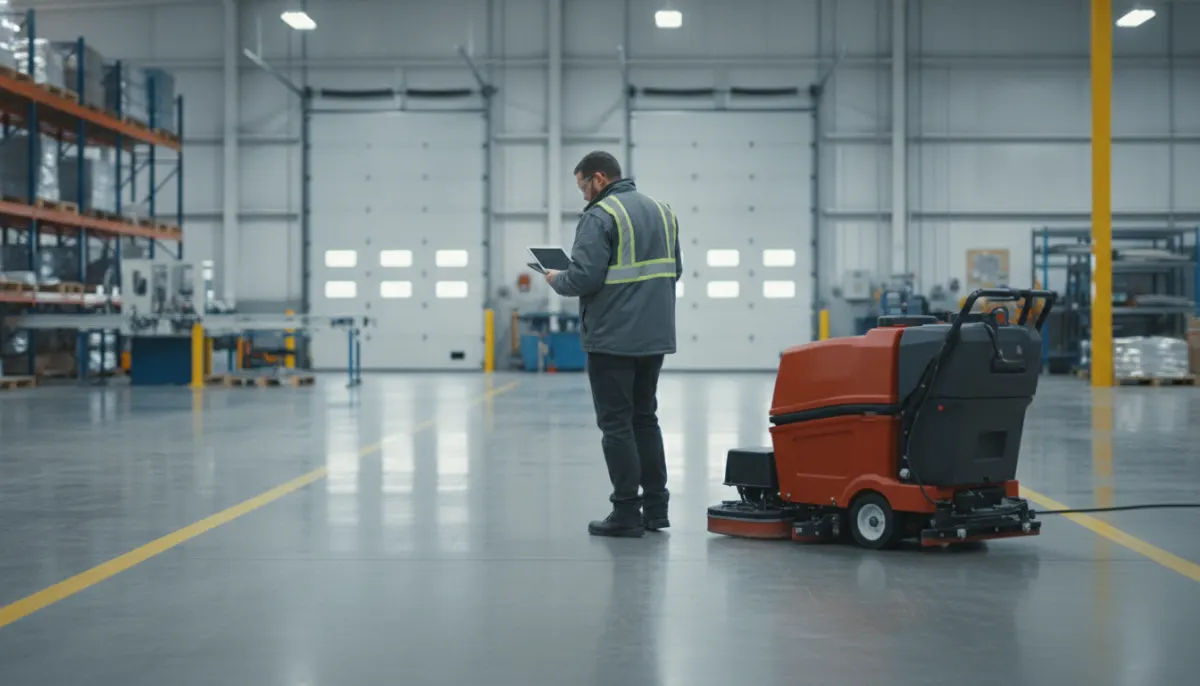
You’ve been handed the job: get three quotes on a new floor scrubber. So you send a two-line email — “please quote a rider scrubber for our plant” — and three very different machines come back at three very different prices.
That’s not a quoting problem. It’s an RFQ problem. A good floor scrubber RFQ tells vendors exactly what your floor needs, so every quote answers the same question and you can compare them side by side.
Here’s what to put in it, section by section.
Start With the Floor, Not the Machine
The most common mistake is naming a machine before describing the job. Lead with the facility, and let the vendors tell you what fits.
Your RFQ should describe:
- Square footage to be cleaned — and whether it’s one big open area or broken up by racking, production lines, and doorways
- Floor surface — sealed concrete, bare concrete, epoxy, coated, or a mix, plus any expansion joints, ramps, or drains
- What’s on the floor — dust, pallet debris, metal chips, oil and coolant, resin pellets, tracked-in salt, food soils
- Narrowest aisle and tightest turn the machine has to make
- How often you want it cleaned, and during which shifts
- Who runs it — a dedicated operator, or whoever’s free that day
That last one matters more than people think. A machine that’s simple to run gets used. One that isn’t sits in the corner.
Spell Out the Operating Conditions
Next, give vendors the details that drive the build of the machine, not just its size.
Power and charging. Do you want battery, propane, or are you open to either? Where will it charge, and is there a dedicated outlet there? If you’re considering lithium, say so up front so everyone quotes the same battery type.
Environment. Note anything unusual — a freezer or cold dock, a dusty process area, a food zone with washdown rules, or outdoor lots the machine will cross.
Run time. Instead of guessing a number, describe the shift: “needs to scrub the main aisles in one pass during second shift without a recharge.” Let the vendor match the battery package to that.
Ask for Specs in the Same Format
Here’s where quotes usually stop lining up. One vendor quotes a disk deck, another quotes cylindrical, a third quotes an orbital — and the spec sheets all use different terms.
Ask every vendor to list the same items for the machine they’re proposing:
- Scrub path width and squeegee width
- Deck type (disk, cylindrical, or orbital) and why they chose it for your floor
- Solution and recovery tank capacity
- Battery type and expected run time for your described shift
- Machine weight and overall dimensions, including turning clearance
- Down pressure settings
- Whether it’s a walk-behind, stand-on, or rider
Ask them to cite the manufacturer’s official spec sheet, not their own summary. That keeps everyone honest and makes the comparison a lot easier.
If you’re between sizes, a good vendor will show you options. For example, Factory Cat makes walk-behinds like the Mag-HD, mid-size and full-size riders like the GTX and GTR, and the heavy-duty XR for the toughest plant floors. Kodiak’s K42 rider comes with several deck choices. Browsing our floor scrubber lineup before you write the RFQ helps you know what to ask for.
Don’t Forget the Stuff That Isn’t the Machine
The sticker price is only part of what you’re buying. The best RFQs make vendors put the rest in writing.
Warranty. Ask what’s covered, for how long, and whether labor and travel are included or just parts.
Service. Who services the machine, how far away they are, and how quickly they typically respond. A local technician who knows your machine beats a toll-free number every time.
Parts. Ask whether common wear parts — squeegee blades, brushes, pads, filters — are stocked locally, and how fast less common parts arrive.
Training. Ask for operator training at delivery, in writing. Your team should know daily checks, tank cleanout, and how to adjust the squeegee before the vendor leaves.
Delivery and setup. Is delivery included? Will they set up the charger and run the machine on your floor?
Preventive maintenance. Ask for a quote on a scheduled maintenance plan, even if you don’t buy it right away. It tells you what ownership really looks like.
Ask for a Demo — on Your Floor
A spec sheet won’t tell you how a machine handles your dock plate, your tightest aisle, or that oily corner by the presses.
Put a demo request in the RFQ. If a full demo isn’t practical, a short-term floor scrubber rental is a low-risk way to test a machine on your actual floor before you commit to buying one.
Ask for Options, Not Just One Price
Give vendors room to be useful. Ask for:
- A base quote on the machine they recommend
- An alternate — a size up or down, or a different deck type — with a short note on the tradeoff
- Rental, lease, or purchase pricing if you’re open to them
- Trade-in value if you have an old machine going out the door
When the quotes come back, compare them line by line against your RFQ. The cheapest quote that skips training, local service, and parts support usually isn’t the cheapest machine to own.
A Simple RFQ Outline You Can Copy
- Facility overview — square footage, layout, floor surface, soils
- Operating conditions — shifts, frequency, power, charging location, environment
- Required spec list — same items from every vendor, from the manufacturer’s spec sheet
- Support — warranty, service response, parts availability, training, delivery
- Demo or trial — on-site, on your floor
- Pricing — base, alternate, rent/lease/buy, trade-in
- Deadline and contact — when quotes are due and who to send questions to
Not sure what to put in section one? Our machine finder walks you through it.
FAQ: Floor Scrubber RFQs
Should I name a specific model in my RFQ? Only if you’ve already tested it and know it fits. Otherwise, describe the floor and the job, and let vendors recommend. You’ll learn more from the recommendations than from a fixed model number.
How many quotes should I get? Enough to compare fairly — and only from vendors who can actually support the machine after the sale. Service and parts matter as much as price.
Is it okay to ask for a rental before buying? Yes. Renting the machine you’re considering is one of the best ways to confirm the fit, especially for a new facility or a floor you’re not sure about.
What’s the biggest thing people leave out? Support. Warranty terms, local service, parts availability, and training are where quotes really differ — and where problems show up a year later.
Let’s Build the Quote Together
At Wisconsin Scrub & Sweep, we make buying floor care equipment simple. Whether you’re writing your first floor scrubber RFQ or replacing a machine that’s been running for years, our team will walk your floor, recommend the right Factory Cat or Kodiak machine, and put every detail in writing — no pressure, no runaround. Send us your RFQ or contact our team to set up a floor walk. Give us a call at (262) 333-0799 or reach out online — we’d love to earn your business.