
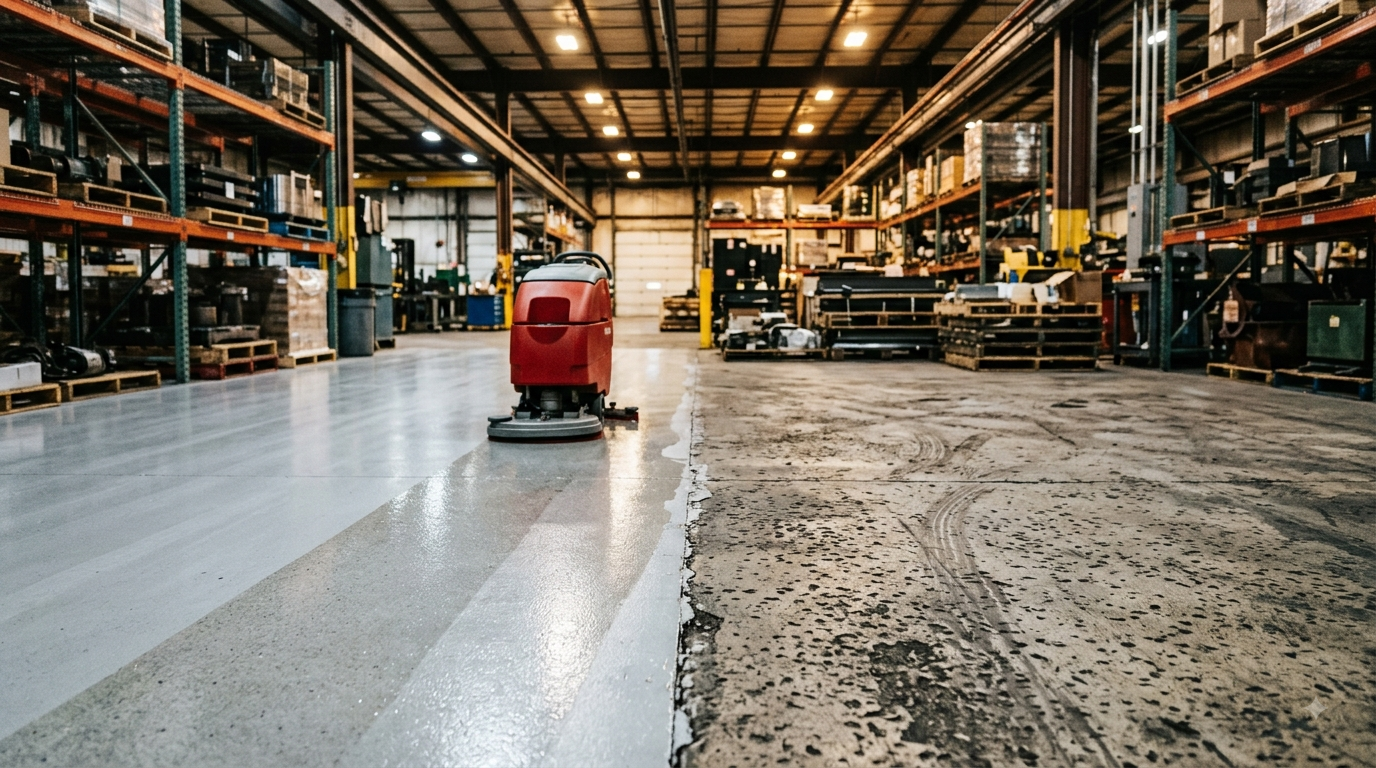
Ask ten facility managers what kind of floor they have and most will say the same thing: "concrete." But if you've walked more than a few Wisconsin plants, you know that answer hides a lot of variety. The glass-smooth troweled floor in a new distribution center and the pitted, forty-year-old slab in a fab shop are both "concrete" — and they clean completely differently.
The best floor scrubber for concrete floors isn't one machine. It's the machine — and more specifically, the scrub deck and pad or brush combination — that matches your surface. Get that match right and you'll clean faster, use less water, and stop burning through consumables. Get it wrong and you'll chase streaks, leave dirt in the low spots, and wonder why your "heavy-duty" scrubber isn't cutting it.
Here's how to read your floor and pick accordingly.
Why Surface Profile Matters More Than Square Footage
Most scrubber buying advice starts with square footage. That tells you what size machine you need — but not what kind. Two floors of identical size can demand completely different scrub decks.
The key variable is surface profile: how smooth or rough the concrete actually is. A smooth floor lets a flat pad make full contact and do its job. A rough or pitted floor leaves that same pad riding on the high spots while soil sits untouched in the valleys. That's where deck style — disk vs. cylindrical — becomes the whole ballgame.
Smooth Troweled or Burnished Concrete
What it looks like: New warehouses, distribution centers, and modern manufacturing space. Steel-troweled during the pour, often burnished to a low sheen. Flat, tight, minimal texture.
What works: This is disk deck territory. A disk scrubber with a standard scrubbing pad makes full, even contact across a smooth surface and delivers the most efficient clean per pass. Machines like the Factory Cat walk-behind lineup or a Kodiak rider with a disk deck will handle these floors all day.
Watch out for: Over-aggressive pads. On smooth concrete, an aggressive grit brush isn't buying you anything — it's just wearing your floor and your consumables budget. A mid-range pad with the right chemical does the work.
Broom-Finish and Rough-Textured Concrete
What it looks like: Loading docks, exterior-grade slabs poured indoors, older plants where the finish was never troweled tight. Run your hand across it and you'll feel ridges.
What works: Cylindrical brush decks earn their keep here. The counter-rotating brushes reach down into the texture that a flat disk pad skates over, and they sweep up small debris at the same time — one pass instead of sweep-then-scrub. Both Factory Cat and Kodiak machines are available in cylindrical configurations for exactly this kind of floor.
Watch out for: Trying to force a disk machine to work on heavy texture. You'll see it in the results — clean high spots, dirty grout lines and valleys, and streaking that no amount of squeegee adjustment fixes.
Polished and Densified Concrete
What it looks like: The showpiece floor — mechanically polished, densified with a hardener, reflective. Increasingly common in food and beverage plants and newer industrial construction.
What works: A disk machine with a soft, non-abrasive pad. The goal is to clean the floor without dulling the polish you paid good money for. Consistent, frequent scrubbing with neutral chemical actually maintains the shine — the scrubber becomes part of the floor's upkeep program, not a threat to it.
Watch out for: Aggressive pads and harsh chemistry. Both will haze a polished floor over time. If your team runs multiple floor types with one machine, make pad changes part of the routine — pads are cheap, re-polishing isn't.
Coated Floors: Epoxy and Urethane
What it looks like: Sealed and coated slabs in food processing, breweries, chemical plants, and shops that need chemical resistance or a cleanable finish.
What works: Similar rules to polished concrete — soft to mid-range pads, moderate down pressure, and chemical that's compatible with the coating. Coated floors are usually smooth, so disk decks perform well. The coating itself makes soil release easier, which means you can often run lighter pressure and less chemical than you would on bare concrete.
Watch out for: Anything abrasive enough to scratch or wear through the coating, especially in high-traffic lanes where the coating is already thinnest. If you're seeing wear stripes down your aisles, adjust before the coating fails — recoating a production floor is a shutdown-level project.
Old, Pitted, and Spalled Concrete
What it looks like: Decades of forklift traffic, dropped parts, freeze-thaw cycles, and chemical exposure. Pits, spalls, exposed aggregate, patched sections. Common in foundries, fab shops, and older Wisconsin plants that have earned every scar.
What works: This is the strongest case for a cylindrical deck with stiff brushes — the bristles get down into pits and follow an uneven surface in a way no flat pad can. A heavier machine with solid down pressure helps too; this is where rugged, all-metal construction like Factory Cat's pays off, because rough floors punish lightweight machines.
Watch out for: Water recovery. Pitted floors hold water in the low spots, so squeegee condition matters more here than anywhere else. If your machine is leaving puddles in the pits, look at brush style and squeegee wear before blaming the machine. Our service and parts team sees this one constantly — and it's usually a quick fix.
Not Sure What You Have? Test Before You Buy
If your facility mixes several of these surfaces — smooth aisles, rough docks, a coated production area — you don't have to guess. Renting a machine and running it on your actual floors is the cheapest insurance there is. A week with a rental floor scrubber on your own concrete tells you more than any spec sheet.
FAQ
Can one scrubber handle multiple concrete types? Often, yes — with pad and brush changes. A disk machine can move from smooth to polished to coated floors just by swapping pads. But if a big share of your floor is rough or pitted, a cylindrical deck is worth speccing from the start.
Disk or cylindrical — which should I default to? If your floor is smooth and you pre-sweep, disk decks are simple and efficient. If your floor is textured, pitted, or collects debris, cylindrical does double duty. When a floor is truly mixed, we'll usually walk it with you before recommending either.
Does a new machine matter more than the right deck? No. The right deck on the right floor beats a newer machine with the wrong one, every time. Start with the surface, then pick the machine.
At Wisconsin Scrub & Sweep, we make buying floor care equipment simple. Whether your floors are polished showpiece concrete or a slab that's survived forty years of forklifts, our team will match you with the right Factory Cat or Kodiak configuration — no pressure, no runaround. Browse our new Factory Cat and Kodiak equipment, or give us a call at (262) 333-0799 — we'd love to earn your business!